
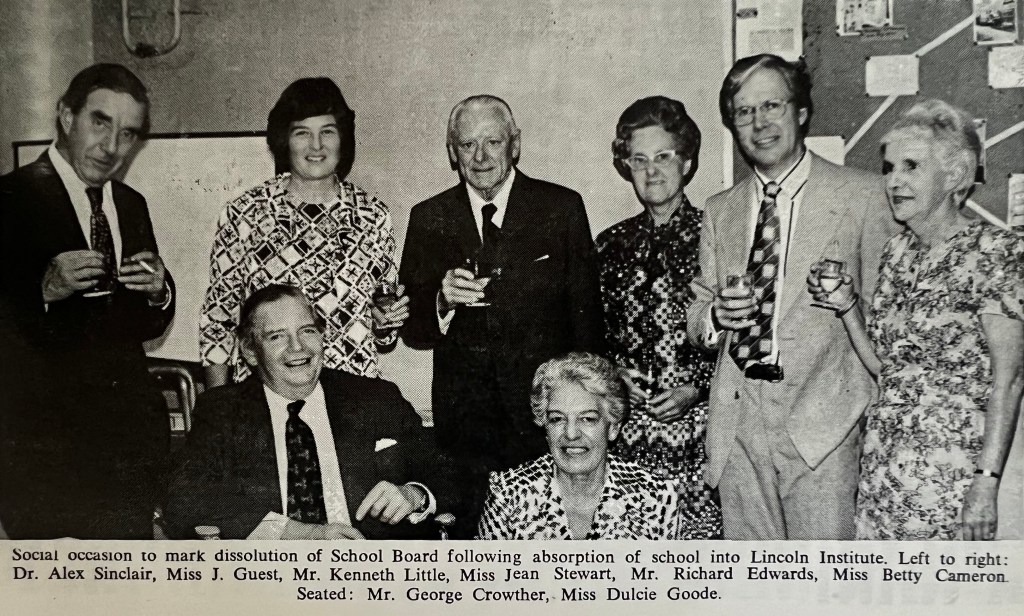
Dolcie Goode
Dulcie Goode was a pioneering figure in the Australian and international occupational therapy field. After graduating from The Occupational Therapy School of Victoria, she became a key member of its board in 1954. Her journey took her to Britain in 1958 for TMAOT training at the Liverpool School, and she later represented the World Federation of Occupational Therapists at WHO assemblies in Geneva and India.
Upon her return, she took on the role of Director at the Occupational Therapy School of Victoria, where she worked tirelessly to enhance the School’s visibility and financial stability. Her efforts included increasing student enrollment, supporting innovations in educational methods, revising the curriculum to align with the evolving societal needs for innovative preventive health measures and contemporary rehabilitation practices, and recuriting men into the profession. She advocated for interdisciplinary collaboration and supported research initiatives among staff.
Dulcie Goode, alongside her colleagues in Speech Therapy and Physiotherapy, played a crucial role in persuading the Victorian Department of Health to acquire the Davies Coop premises for a unified allied health training center. Reflecting this moment in the history of the Lincoln Institute, and the acquisition of 625 Swanston Street for a combined therapy training centre, Miss Goode commented: “I had always felt that the ideal place would be a factory and that quite likely one would be found near the University and major teaching hospitals”.
The 1970 Annual Report of the Victorian Association of Occupational Therapy honored her contributions, acknowledging her leadership in guiding the School through transformative years. ‘Miss Goode retired knowing that she had guided the School through a period of rapid growth and expansion, and that she was handing over a School whose programme is respects in Occupational Therapy circles, throughout world’.
Her foresight were accurate. The Lincoln Institute became a top institution in Victoria, specializing in health sciences education and clinical innovation. Important steps were taken to professionalize occupational therapy, which later helped it grow in the university setting. This led to hiring many academic OT staff, creating a four-year degree program with an historic high of 60 students, and developing a unique professional identity that represents its own knowledge and clinical practices within a large disciplinary nomenclature called “health sciences.”
 Lincoln Institute of Health Sciences